

Roster Management Software vs. Excel and Airtable
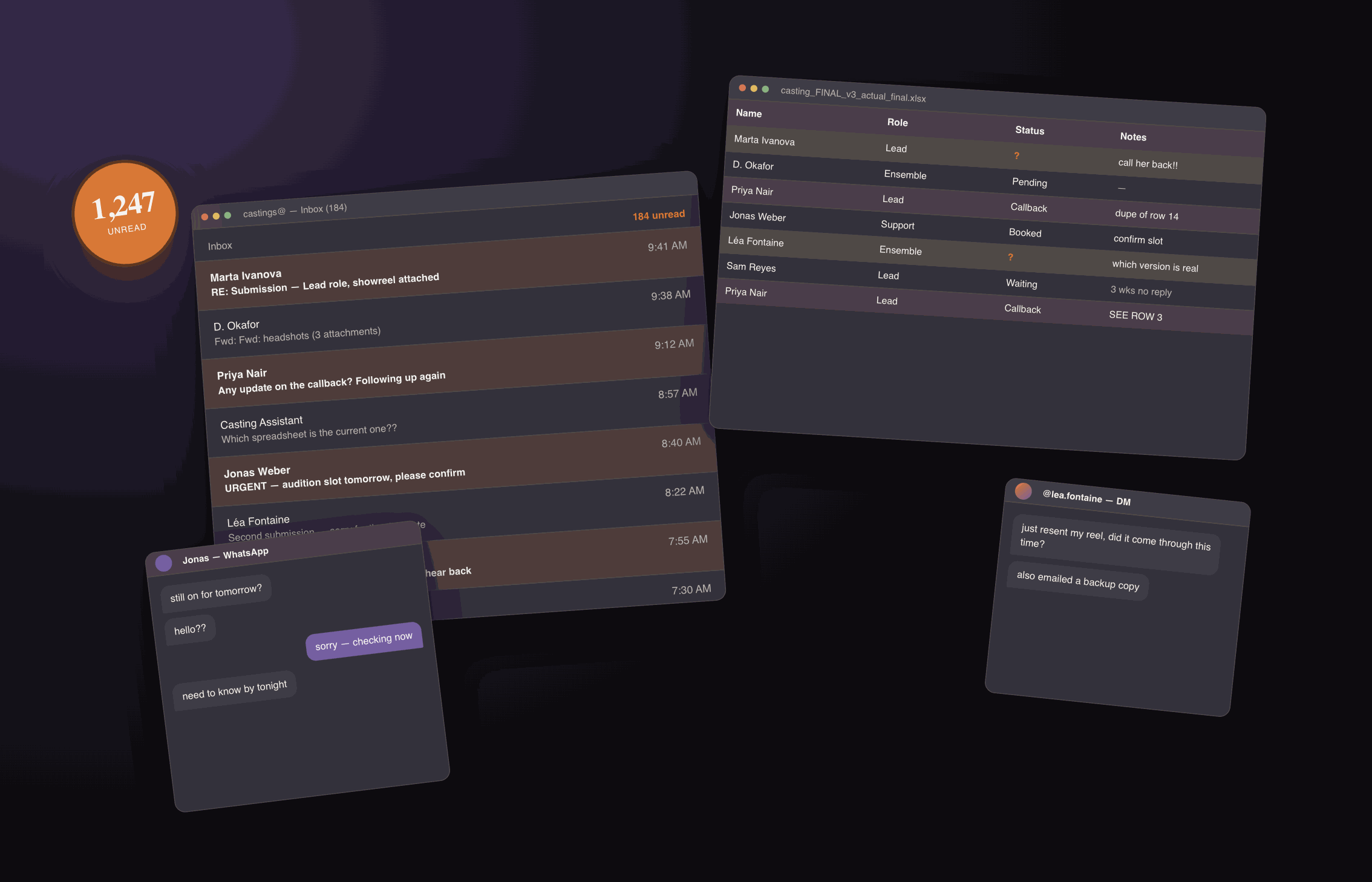
There's a specific kind of dread that comes with opening a talent spreadsheet you haven't touched in three weeks. You know what's waiting: three tabs, half of them outdated, a column for "notes" that's really just a graveyard of things you meant to follow up on, and at least one person whose name you can't remember why you added.
We've heard some version of this from almost every casting team and talent agency we've talked to, whether that's a theatrical agency booking actors for a TV pilot, a modeling agency juggling client bookings, or a background/extras agency running open calls. Not because they're disorganized. Because the tools they're using were never built to keep a roster alive. They were built to store it.
Why roster management in a spreadsheet breaks down
Excel and Airtable are fine tools. The issue isn't that they're bad at holding data. It's that they hold it in isolation. Someone applies to your casting call, or a talent agent submits a client for a TV role, and now you have two systems: the inbox or form where the submission lives, and the spreadsheet where your actual talent database lives. Getting someone from one to the other means copying names, re-typing details, attaching a headshot manually, and hoping you didn't skip anyone.
Do that fifty times for one casting call, or every time a TV agency sends over client packages for a pilot, and it stops being admin work. It becomes the job.
If you're looking at Casting Crane as an alternative, it's worth knowing the same gap shows up there: application intake and some form of talent storage exist, but the roster and the applications still tend to live as separate objects that don't really talk to each other. You're still doing the moving yourself, just inside one piece of software instead of two. Castapp, which many productions in the DACH region already use, goes further on structure but comes at enterprise pricing that only makes sense once you're already running large-scale operations.
What talent database software should actually do
The Roster in The Pending isn't a list. It's the place every application, every project, and every talent relationship eventually feeds into.
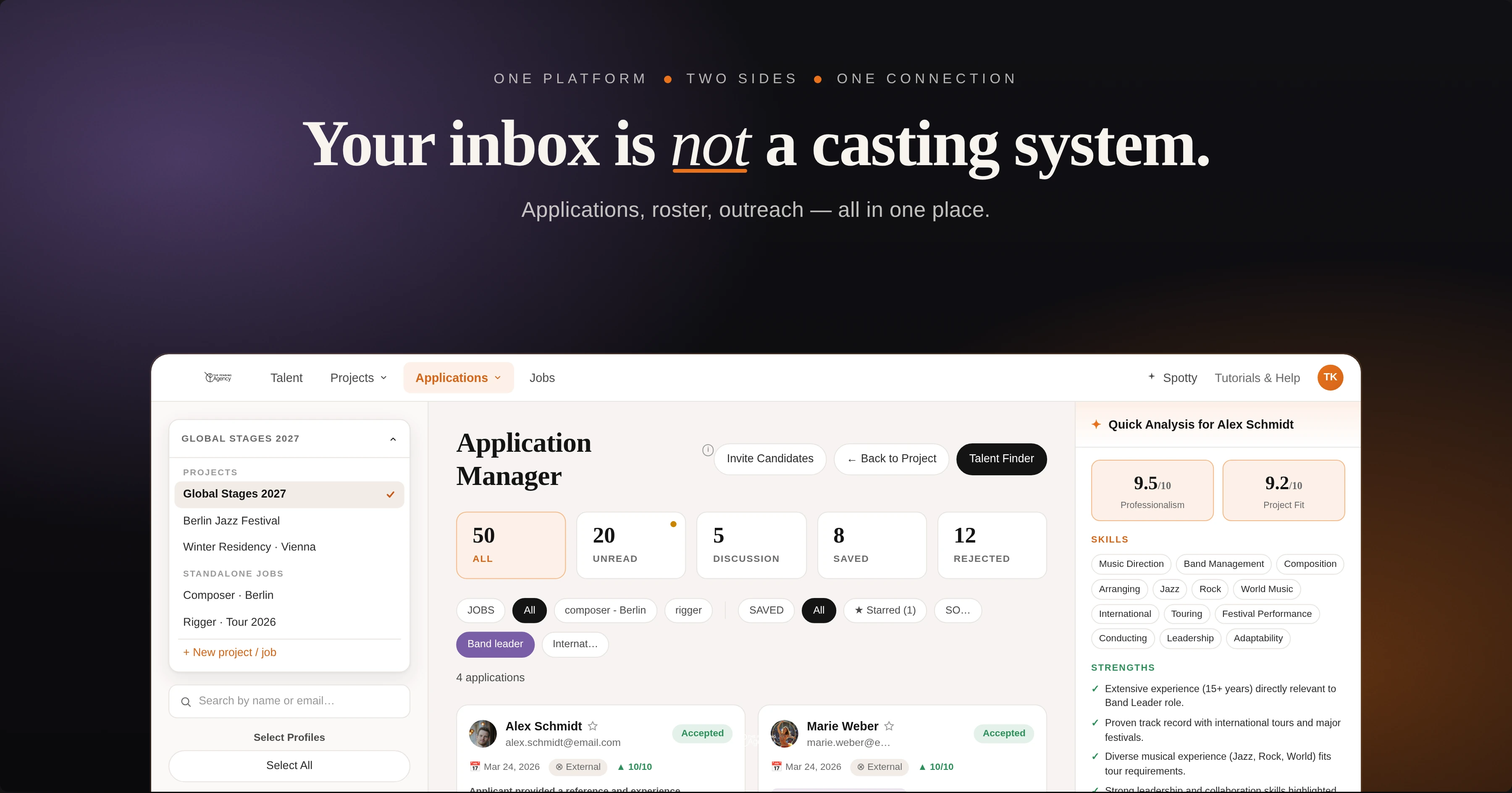
When someone applies through your Application Manager and you decide they're a fit, they don't get copy-pasted anywhere. They move straight into your Roster, headshot, files, application context, and all. If you're on our Professional plan, that transfer happens automatically the moment you mark them as accepted. No re-entry, no second system to maintain.
And the Roster isn't flat. You've got a central Roster for your whole talent pool, and separate project-specific Rosters for whoever's relevant to a given production or casting call. Profiles can move between them, get copied, or stay synced, depending on how you work. Each profile keeps its own history too: the application it came from, notes from your team, an activity log of everything that's happened since. So a year later, when that same person applies again, you're not starting from zero.
The part people usually miss
The real value isn't the Roster on its own, and it isn't the Application Manager on its own. It's that they're the same system.
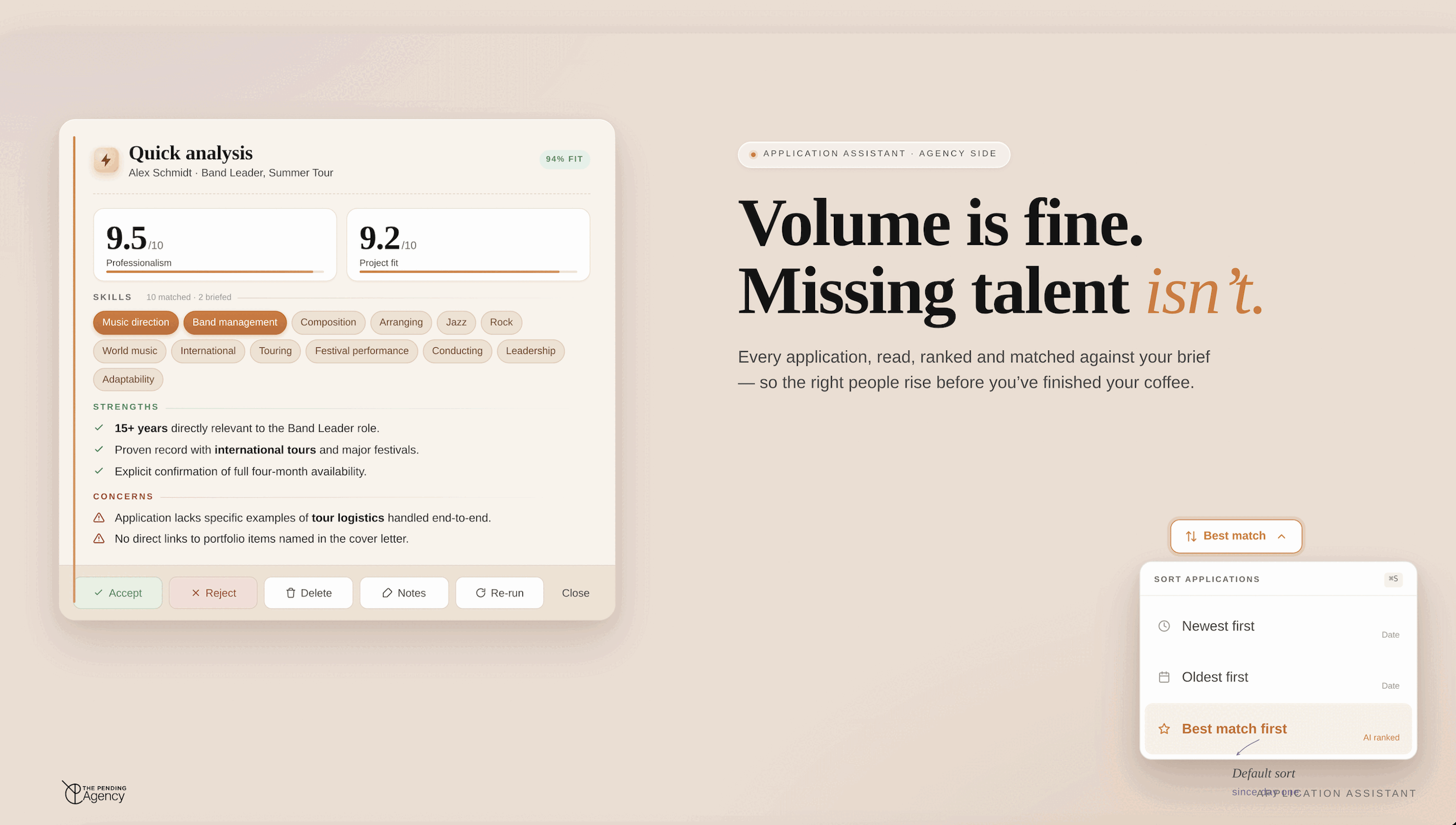
Picture a casting call with 300 applicants, or a talent agency fielding client submissions for a national commercial. Spotty pre-sorts them against your project criteria, work permits, location, discipline, whatever matters for that role, so you're not scrolling through every submission in order of arrival. The ones who fit go into your pipeline. The ones you accept land in your Roster automatically, already tagged to that project. Next time a similar booking comes in, whether it's a modeling agency filling a lookbook shoot or a background agency staffing a film set, they're already there, searchable, with the context of how they came to you in the first place.
That's the difference between a database you maintain and one that grows on its own while you're busy doing the actual work with talent.
Built for casting teams and agencies who'd rather work with talent than data-entering
None of this is about replacing judgment with automation. Spotty pre-sorts, it doesn't decide. Every shortlist, every match, still gets reviewed by you. What we're removing is the tedious bridge between "someone applied" or "a submission came in" and "we have their info where we need it," whether you're a casting director, a talent agent, or running a modeling or background agency.
If your current setup is a spreadsheet you dread opening, or a tool that stores your roster but leaves you doing the connecting by hand, that's exactly the gap we built The Pending to close.
Tim & Niklas, Co-Founders
Run your casting in one place
Applications, roster, team review, and client shortlists — The Pending is built for exactly this workflow.
Get started freeRelated articles
Why Most Casting Workflows Break Down
Google Forms, scattered inboxes, no way to track who applied. Here's why most casting workflows break down — and what actually fixes it.
How to Handle 500+ Applications for One Casting Call
Hundreds of applications, one deadline, a small team. Here's how to stay on top of high-volume casting calls without losing good talent in your inbox.
Where We Draw the Line on AI in Casting
Why our AI casting platform screens applications instead of judging talent, and why the full casting workflow still works with AI switched off.

Welcome to The Pending 2.0
Why we built The Pending — and how 2.0 brings artists and agencies together with real tools instead of Google Forms and inbox chaos.